
Ice Performance Lab · Hockey Medicine & Performance
Tools & Resources
Practical prompts for better conversations about hockey health, workload and return to play. Use the worksheets as a starting point for a team review.
← Back to the frameworkFree pilot · Personal journal
Your week, saved.
Keep session and recovery records in your browser, review seven-day trends and export your journal.
Saved on this device. No account needed. Export a backup regularly.
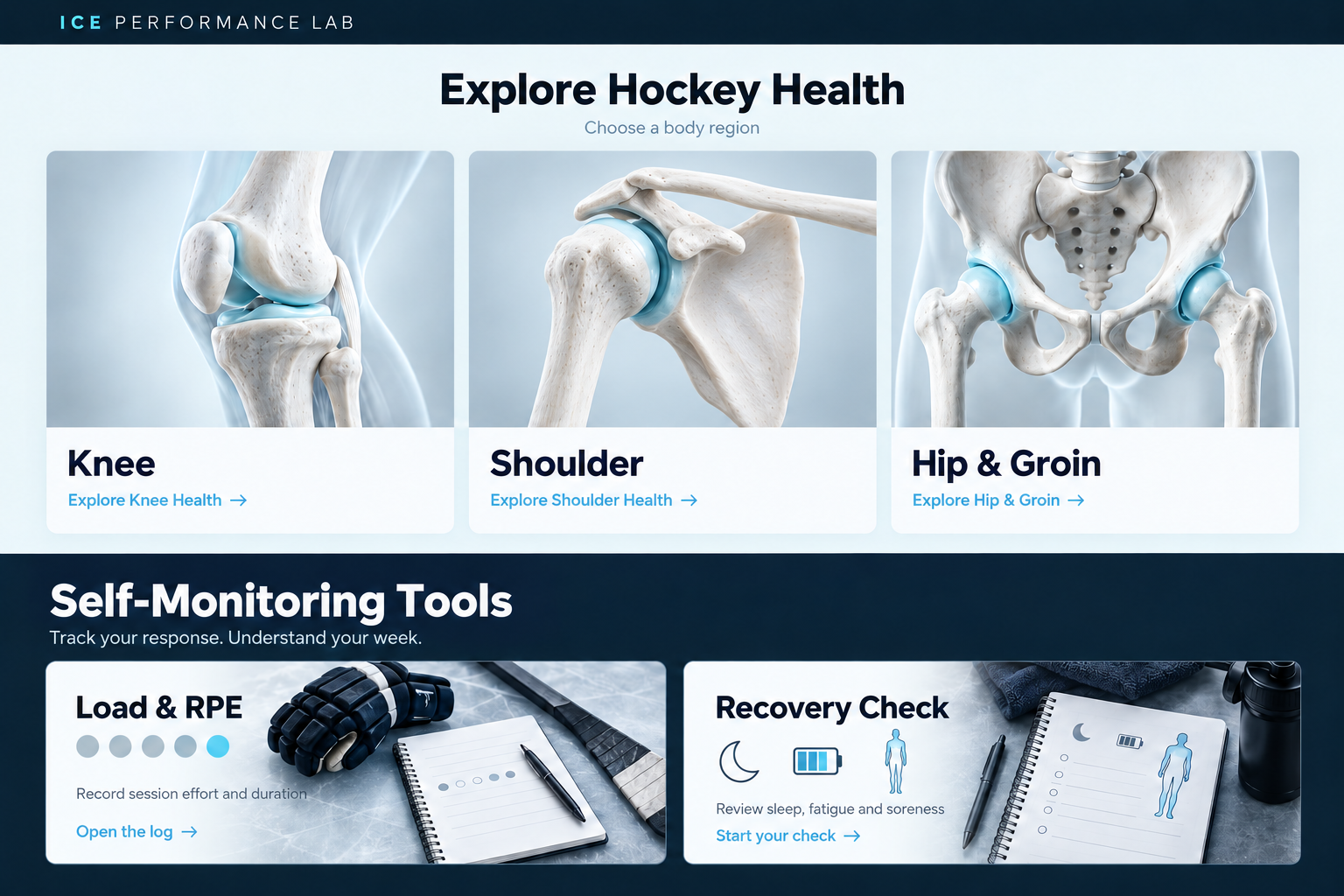
Self-monitoring tools
Track your response. Understand your week.
Two practical worksheets to complete in your browser and print or save as a PDF.
Professional assessment · Interactive test library
Find tests by body region.
Explore 40 assessment options across nine body regions, with equipment notes, interpretation limits, evidence and hockey applications.
Explore the Body Region Test Library →
For medical and rehabilitation teams. Assessment options support clinical judgement; they do not provide an automatic return-to-play clearance score.
Professional workspace · Interactive demo
Build a battery around your equipment.
Select the equipment you can access, choose measurements by body region and explore baseline comparisons in a fictional player workspace.
Fictional data only. Profiles and assessment histories are saved on this browser. Export a backup regularly. No account or cloud player database is connected.
01 / Start here
A simple decision rhythm
The Ice Performance Lab framework turns a complex week into a small set of repeatable questions. The aim is to notice change, agree on a next step and revisit the result. These prompts support discussion; they do not diagnose injury or replace a clinician’s decision.
What changed?
Record a change in symptoms, participation, workload or confidence. Include when it started and what the player could do before.
Who needs to review?
Bring the right people into the conversation: player, clinician, coach and performance staff as appropriate. Set the immediate activity plan.
What happened next?
Check the player’s response after the planned exposure. Update the plan when the response differs from what was expected.
02 / Weekly load review
Five questions worth writing down
Work and response
Which games, practices and off-ice sessions happened? How hard did they feel to the player, and what symptoms or soreness followed?
Recovery and change
How were sleep and recovery? What changed from the previous week in exposure, travel, school or schedule?
05 / The next decision: What is the plan for the next session, who owns it, and when will it be reviewed? Write down the answer so the player and team share the same expectation.
03 / Return to play conversation
A shared handover, step by step
The planned Player Return Pack is a structured handover concept in development. Until a finished pack is available, this short checklist can guide a conversation between the treating clinician, player and team.
Current status
What is the injury or concern, what has been assessed, and are there any symptoms that require further medical review?
Allowed activity
What can the player do now? Specify on-ice, off-ice and contact restrictions, if any, and identify who can change them.
Progression
What exposure comes next, what response is expected, and what would pause or change the progression?
Communication
Who communicates the decision to the player, coach and support staff? When is the next review?
See also Return to Play for the staged pathway. The pack described here is a project concept, not a downloadable or validated clinical tool.
04 / Decision language
GO · MODIFY · STOP
Follow the agreed plan
Proceed with the exposure that the appropriate care team has cleared, then document the response.
Adjust the dose
Change intensity, duration, contact or task complexity when the plan calls for a smaller step or the response needs review.
Pause and reassess
Stop the planned activity and seek appropriate assessment when new or worsening symptoms or other concerning signs appear.
Use with care: these are shared communication labels, not a self-clearance algorithm. Suspected concussion requires removal from play and assessment by a qualified health professional.
Further reading: Amsterdam 2022 international consensus statement on concussion in sport.